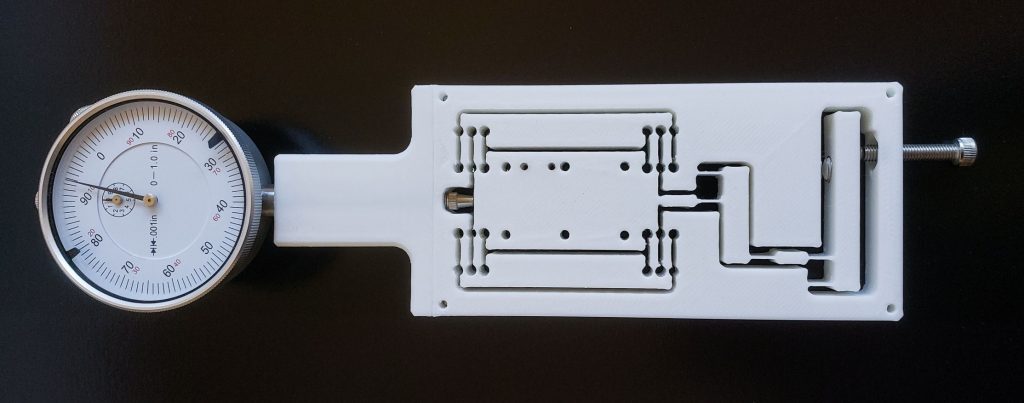
I don’t know if this flexure has an official name but I’m naming this build after Dan Gelbart since I first saw it in his flexure video (below) and he’s a personal hero of mine. His YouTube series on building prototypes is a must-watch for anybody interested in making functional, precise equipment cheaply and quickly.
What’s cool about this mechanism?
Typical of flexures, this mechanism is smooth, has no backlash or stiction and is very repeatable over small distances (I haven’t fully characterized its performance so not sure about larger distances). You can hit fractions of a thou all day with a plastic 3D printed version and Dan Gelbart manages to get 10 nm [0.4 millionths of an inch] with his aluminum waterjet version. When clamped properly you can reliably get 0.5 micron or 20 millionths of an inch on the 3D printed version!
The thing that’s appealing to me about these kinds of demonstrations is that the geometry is doing all the work. It’s all about design, not what kind of manufacturing tolerances you can achieve. This was 3D printed on a standard printer, using cheap stepper motors and a couple bucks of filament and maybe $1 of hardware. Of course there are limitations like thermal stability, travel distance and accuracy etc., but if your question is something like “what kind of precision can be achieved using the least expensive components”, this is a good candidate.
Cost vs. precision curve – For example, if you want to minimize Precision*Cost what are your options compared to this device? Ignoring the dial indicator and assuming the print costs $10 of filament + printer wear, the equation above is 2×10^-5 inch precision * $10 cost = 2×10^-4 ($*in). Keeping this value constant, could you achieve 10 times more precision (50 nm) for 10 times more ($100)? Possibly, but you’d have to be pretty selective about components and design. How about 10 times less precision (.0002″) for 10 times more cost ($1)? Again, maybe, but it would be tricky. This indicates that this mechanism is within an order of magnitude for the level of precision that can be achieved in this price range.
Mechanism details
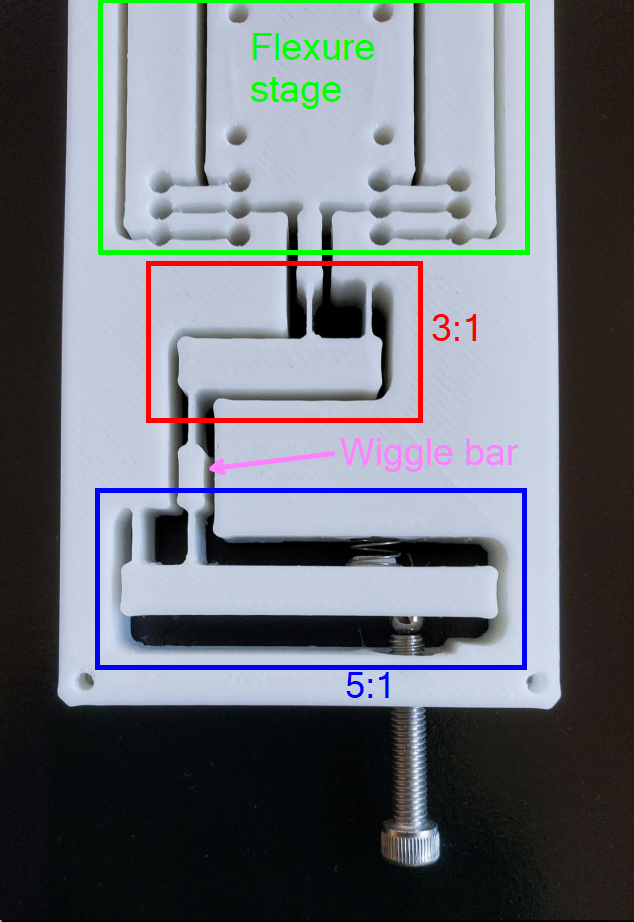
The bottom of the fixture has a 5 to 1 lever that the screw pushes against with a spring counteracting it for preload. A wiggle bar transmits motion to the next stage which is a 3 to 1 lever. This multiplies together with the first lever to give a 15 to 1 reduction in travel. I found it very helpful to have the adjustment screw contacting a ball bearing to maintain a single point of contact as the lever rotates and to compensate for the inaccurate screw tip. This point contact is common in micrometers and other fine adjustment systems.
The next section is a standard linear flexure mechanism. Dan Gelbart’s stage has about 2mm travel with 1 micron deviation from perfect linearity. I would like to measure the specs of mine but need to create a fixture that can measure the linearity accurately enough. It’s 3d printed and probably has terrible thermal stability but I did take the time to drill out the holes on the living hinge sections of the linear stage which makes it a little more accurate.
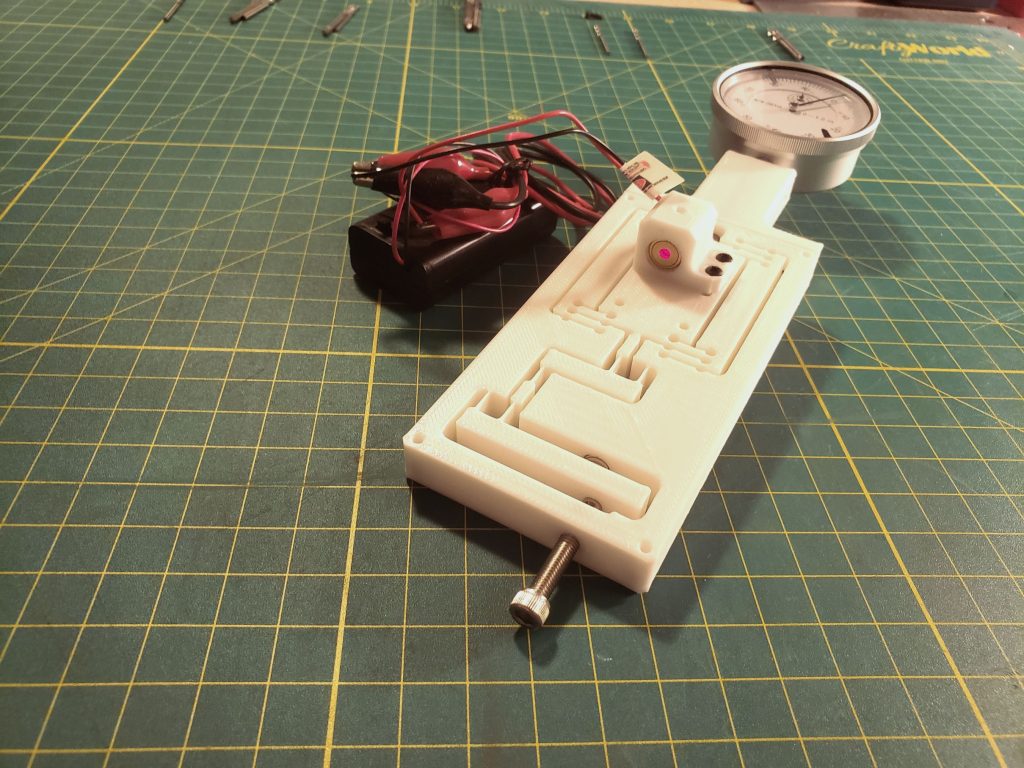
The laser beam is to measure linearity of the flexure stage travel (no noticeable wiggle in the beam from 10′ away during adjustment).
Mechanism precision
I’m sure I could use a micrometer for adjustment but I was already maxing out the resolution of the dial indicator (.0005″) with a 10-32 adjustment screw. With the 15 to 1 reduction, the effective thread pitch is 15 * 32 = 480 TPI (teeth per inch), just over .002″ per turn. A quarter turn is the maximum resolution of my indicator (.0005″). I also measured with a 1 micron indicator and was able to achieve 0.5 micron movements! You have to be very careful about bumping the system at that scale though, since any wobble in the screw can result in jumpy readings.
If I used an 80 TPI adjustment screw I could get .0002″ [5 micron] with 1/4 screw turn. With a micrometer (which uses another cool mechanism, a differential screw), I could get graduations of .001″, resulting in a theoretical resolution of 152 nm. I’m sure at those scales the accuracy and repeatability would be very inconsistent though. I’ve been looking into building an interferometer to see how low I could really go.